
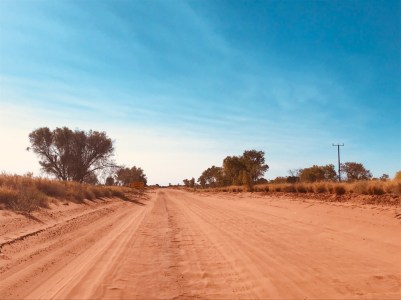
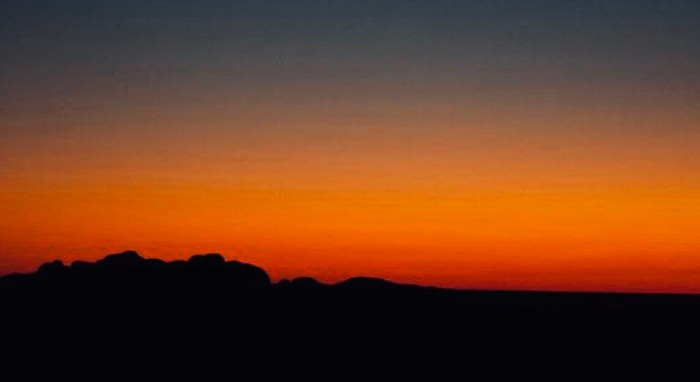
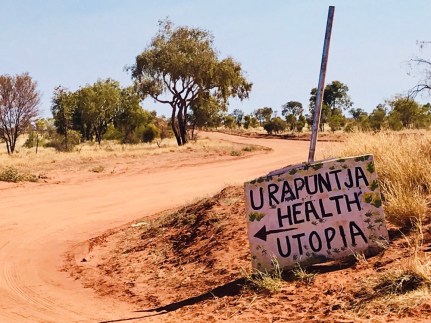
Right now, I am in the middle of nowhere, like slap bang in the middle. There is nothing much for hundreds of kilometres in either direction. It has not rained for over 7 months. Red sands swirl through the vast arid landscape between white ghost gums and over yellow parched grasses. The sky is huge. At the end of the day, as the cold chill sets in, a vibrant bright orange strip smoulders on the horizon to the west as the purple bruise of night creeps in from the east. There is neither a hill nor a river for miles and the eye can see as far as it can see.
I’m working as a remote area nurse, one of five, who provide health services to the aboriginal population that call this place home. Almost every day we load the car with medications, immunisations, diagnostic equipment, treatments, dressings and laptops and head out to one of the 16 outstations in the area.
Each outstation consists of between five and twenty breeze block houses, most are fixed up with corrugated iron and blankets to hide the disrepair. They all have air conditioning, solar power, showers, toilets and kitchens. Maybe they are working but probably not. Otherwise they are almost empty with old mattresses and blankets covering the concrete floors. Outside is a graveyard of dismantled cars abandoned amongst a flowerbed of rubbish where hundreds of feral dogs roam. Everything is covered in a thick layer of red dust.
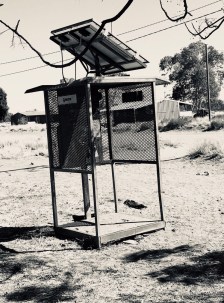 When we arrive, it’s like a ghost town. We drive around, beeping the horn to announce our arrival. The one phone box rings out into the silence, searching for a lost soul. In time, you notice the smoke from a smouldering fire as a curious face lifts out of a pile of blankets nearby. A lone figure leans in a doorway. Suddenly, the doors from the shell of a car are thrown open and 5, 6, 7 young children emerge from their makeshift playground. All the dogs come yapping at the wheels of the car as the place starts to come to life.
In a tiny room we call a clinic, we get to work. Usually there are just two nurses, occasionally a doctor, and up to three patients in this small space.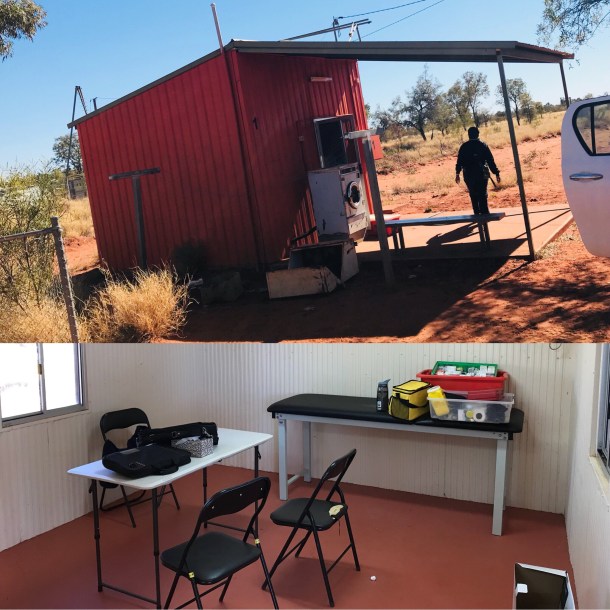
In this environment that is so totally unique, to people from a highly complex, fascinating and diverse culture, in a language that is not their own, we will discuss, assess, diagnose and treat what we can. After the chaos, after the claustrophobia, after the absence of privacy and the loss of dignity, what really, really gets to me is that we are delivering a healthcare service that just doesn’t work. It is a service that was developed to serve middle class urbanites. These are people who have access to education, jobs, services, infrastructure, housing, sanitation and good nutrition. They understand how “we” understand health, because it is the same. Most people think of health as a physical thing whereas the aboriginal people are much more concerned with the cultural and the spiritual. They are connected to each other and to the land. We keep trying though, because we care and because we don’t know what else to do. Is it because we don’t ask? Is it because we don’t listen?
I think I have always had a romantic idea that I wanted to save the world. Slowly I am coming to the realisation that this is all it’s ever going to be: a romantic idea.
When I was working in Ghana, Africa, I taught a session on optimal wound healing. I proudly displayed the many different types of dressings available to me. When I realised all they had was methylated spirit and cottonwool, I thought, what was the point?

In India we ran health clinics in rural areas where we saw so many people in chronic pain because of the hard manual labour they are required to do. We packed them off with a strip of paracetamol. Solving problems? Saving lives?
In the Solomon Islands I delivered hours of training, the same training I had received, to nurses in a developing country, in a foreign language and expected them to understand. Was I surprised when, after a year, I felt I had achieved very little?
On each of these occasions I have deliberated over my reasons for being there. Each time I have come up with the same answer: who am I to tell these people how to do their job, how to live their lives, in their country, with their people? It just doesn’t work.
But these are all examples from third world countries. I guess I never expected to feel the same in Australia.
I’m involved in tick box exercise. I dish out medications for chronic diseases that people don’t even know they have (tick). I lecture them on nutrition when they have no access to fresh produce (tick). We pack patients onto planes to a foreign place for procedures and tests they never asked for (tick). We have a 100% immunisation rate (tick) in a community where people are going deaf and blind from skin infections that could be resolved through better housing alone. And we collect data. Lots of it. We do this because it is the only way we know and we know it works for us (or does it?)
Let me ask you this: If you presented to a health centre with a headache and after being prodded and poked you had to give blood, give urine, have an injection, told to eat better, wash daily, smoke less, walk more, drink nothing but water and given a roll of tablets to take every day that make you feel sick, weak, bloated, dizzy, and, you still had a headache when you left. All delivered in a language you don’t understand by a person you have never seen before and will probably never see again. Would you go back? Would you trust it? I wouldn’t.
I am new to this and I still have so much to learn. I will get better, both culturally and clinically but I am not what these communities need. They need people who will be in it for life. They need people who will live within the community, who will learn the language and who will listen. Hopefully, eventually, they will not need us at all. Right now, I am filling a gap and it works for me. I want to save the world, but in my own time. 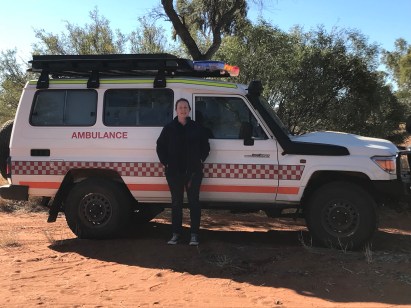
My dad (AKA Bob: The Critic) say’s that I need to put some positives in and do you know what? He’s right (as always). I do tend to focus on the drama and the negative but honestly, I am having a great time. Everyday is a fly by the seat of your pants adventure. Out here, you are it: doctor, nurse, paramedic, midwife, pharmacist, educator, cleaner, driver. We will deliver your medications, we will pick you up and drop you home. We don’t have appointments. We will see you whenever you need us. Sometimes in your own home. Sometimes in the middle of the bush, in the middle of the night. Our consultations have no time limit and you can discuss more that one ailment at a time (imagine that!) and we will go above and beyond to do everything we can to try to save your life if you are unlucky enough to need it. As a nurse, my skills, knowledge and adaptability are pushed to the limit on a daily basis, everyday challenging. Sometimes its awful, but that’s nursing. Its the amazing people and the good times that pull you through. I certainly intend to stick it out a little longer.
 annamayventure
Your piece is fascinating. Everything you do has consequences and that might not be the ones you see today. Although the immediate result of your piece in my mind was “Wow!” You managed to convey a completely different life and place to the other side of the world. I love how, from a non medical perspective, they have taken what they wanted from our society (eg old vehicles) and ignored the rest, keeping hold of what they value. Maybe that’s something I could learn from them! Eg how to use technology and not let it take over my life.
Thanks Anna and please keep sharing.
LikeLike
Brilliant! (And good to see where you ended up)
LikeLike